 FREE SHIPPING ON ORDERS ABOVE £ 49 ACCROSS THE UK ONLY


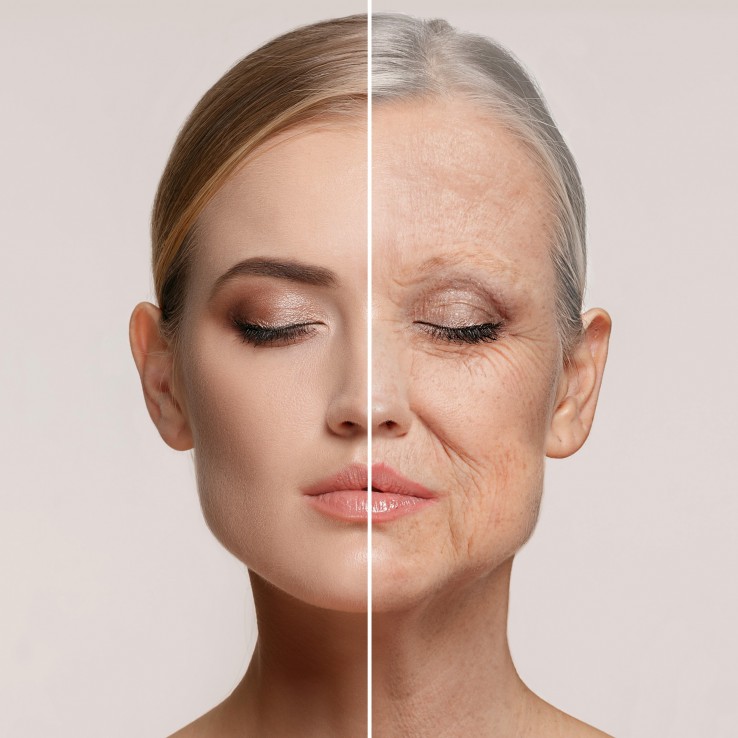
Although it is said that wrinkles on the face reflect a person’s wisdom and life experience, many people, especially women, would like the signs of aging to be as inconspicuous as possible. For centuries, humanity has dreamed of discovering a remedy for aging or at least for its most obvious sign – skin wrinkles. The famous alchemist Count Alessandro Cagliostro was imprisoned because his youth elixir… was ineffective.
The 20th century introduced many more such elixirs. Every few years, cosmetic companies announce in their advertisements that they have finally discovered a panacea for skin aging. Eucerin, glycerin, lanolin were supposed to be that long-awaited solution, but they were not. Later, antioxidants or vitamins E and C, beta-carotene, liposomes – particles that transport active ingredients to skin cells, hormonal creams, fruit acids, selenium, vitamin A, coenzyme Q10… each of these was supposed to reverse aging but, at best, only slowed it down. Why? Because, over time, the body loses its ability to synthesize collagen, the structural collagen protein produced by fibroblasts, which form a protein network that binds water in the skin. It turns out this is the problem to solve to invent an effective anti-wrinkle remedy.
WHAT IS COLLAGEN?
The word collagen comes from Greek: colla – glue, genno – to produce. “Glue production” perfectly describes collagen’s function: to “glue” or “join” cells, forming tissues and organs.
It is one of the body’s most important proteins, abundant in the skin and throughout the locomotor apparatus (bones, cartilage, tendons, ligaments, muscles), as well as in teeth, gums, the eye’s cornea, blood vessels, internal organs, and tissues.
Collagen is exceptionally resistant to stretching: a collagen fiber with a diameter of 1 mm can support a weight of 10 kg without breaking!
COLLAGEN STRUCTURE
Collagen is a protein whose structure consists of a triple helix made of a repeating sequence of amino acids: glycine-X-Y. Glycine* is present in almost every triplet sequence, and the other two amino acids in the helix are random, meaning X and Y can be any of the 20 amino acids typically found in proteins. Proline, hydroxyproline, and alanine often take the X and Y positions. Proline and hydroxyproline make up about 20% of collagen, and alanine about 10%.
COLLAGEN SYNTHESIS AND AGE
Fibrous collagen and elastin are protein structure components in the dermis that determine the skin’s turgor. Turgor refers to tissue elasticity and firmness, dependent on their physiological state. As natural skin aging occurs, the skin becomes thinner, looser, and less elastic.
With age, fibroblasts produce less collagen and elastin and secrete more elastase enzyme, which breaks down these protein structures. Free radicals activate elastase production.
In children and young people, collagen fibers constantly renew, but as time goes by, collagen synthesis weakens.
COLLAGEN FIBER IN YOUNG AND OLD SKIN
Free radicals reduce collagen elasticity, while hormonal changes associated with aging (during menopause, skin loses elasticity and firmness several times faster) and negative external factors (smoking, UV rays, pollution) slow down collagen synthesis. As collagen’s ability to absorb and retain water gradually declines, the skin loses moisture, elasticity, and firmness; sweat and sebaceous glands atrophy, and joint flexibility decreases.
Starting around age 25, the body loses about 1.5% of its natural collagen each year. By age 35, our body has lost 15%, and by age 45, as much as 30% of its collagen.
COLLAGEN TYPES
Depending on the specific organ affected, there are several types of collagen: Types 1 and 3 are most common. In some tissues, collagen is gel-like (in the vitreous humor of the eye), while in others, it forms fibers (in tendons).
- Type 1 collagen is found in the skin, tendons, blood vessels, internal organs, and bones.
- Type 2 collagen is essential for cartilage, comprising about 50% of its dry weight and determining the strength and elasticity of joint cartilage.
- Type 3 collagen is characteristic of the eye retina and small capillaries.
Collagen tripeptides are a source of building materials essential for the renewal of articular cartilage, subchondral bone tissue, other joint tissues, the joint capsule, tendons, and ligaments. They influence the metabolism of cartilage and bone cells, enhance collagen synthesis, and prevent further cartilage degradation.
The accumulation of collagen tripeptides in cartilage increases collagen chain synthesis in cartilage and bone cells, contributing to the regeneration of articular cartilage, subchondral, and bone tissues.
FUNCTIONS OF COLLAGEN PROTEIN
- Actively participates in tissue repair (regeneration)
- Intensively hydrates the skin, promoting cellular metabolism and regeneration
- Promotes hair growth, strengthens nails
- Improves joint mobility, increases bone density
- Enhances vision
- Maintains gum health by providing firmness and elasticity
- Ensures the elasticity of blood vessel walls
- Softens the edges of postoperative scars and promotes wound healing
- Used in medicine for conditions like stomatitis, herpes-related diseases and their effects, abscesses, wounds, and abrasions
COLLAGEN ABSORPTION MECHANISM
Collagen is a protein whose structure consists of a triple helix made of a recurring sequence of amino acids: glycine-hydroxyproline-proline. In the digestive tract, collagen protein breaks down into peptides and free amino acids. Peptides are easily absorbed through the peptide transporter in the walls of the small intestine and, upon entering the bloodstream, are distributed throughout the body – reaching the skin (dermis) and other organs.
Once in the dermis, collagen acts in two ways:
- Collagen peptides and free amino acids serve as building blocks for collagen and elastin fiber production.
- Collagen tripeptides stimulate fibroblast proliferation – connective tissue cells that produce components of the extracellular matrix, such as collagen, elastin fibers, glycoproteins, and glycosaminoglycans – thereby promoting the natural synthesis of collagen and hyaluronic acid.
The collagen in the skin is produced by fibroblasts, which are connective tissue cells in the dermis responsible not only for collagen matrix production but also for elastin and hyaluronic acid synthesis. Fibroblasts are sensitive to physical and chemical stimuli that can activate their activity and proliferation. Activation of fibroblasts leads to an increase in collagen production.
References
- Improvement in the Moisture Content of the Stratum Corneum Following 4 Weeks of Collagen Hydrolysate Ingestion. Nippon Shokuhin Kagaku Kogaku Kaishi, 56, 137-145 (2009).
- Synergistic effect of collagen peptide and elastin peptide derived from salmon on promoting hyaluronic acid production and cell growth of normal human dermal fibroblast cells (SF-TY). Nippon Suisan Gakkaishi, 75, 86-88 (2009).
- Oral supplementation of specific collagen peptides has beneficial effects on human skin physiology: a double-blind, placebo-controlled study. Skin Pharmacol Physiol (2013).
- An Overview of the Beneficial Effects of Hydrolysed Collagen as a Nutraceutical on Skin Properties: Scientific Background and Clinical Studies. The Open Nutraceuticals Journal, (2015).
- Final Test Report. Validation of skin-care effect on taking collagen drink. Face Survey Corporation, Osaka, Japan. Study No. 3120504, (2012).
